

Blog
Say’s Law, Artificial Intelligence, and Technological Change.


The impact of Artificial Intelligence (AI) is set to rapidly expand beyond education and the writing of website material. In 2024, global investment in AI is estimated at US$252.3 billion. Private investment from the United States is by far the largest of any country. In 2024, private investment from the U.S. was estimated at US$109 billion. Private investment from Europe and China were US$19.4 and $9.3, respectively. The Stanford University HAI reports that Marketing and Sales, along with Supply Chain and Logistics, experienced the largest increases in AI usage in 2024.
The disruption to the labor market due to advances in AI technology is widely forecast. The integration of robotics with AI is already evident in Amazon. Amazon Vice-President Robotics, Scott Dresser, begins a media release (30 June 2025) with these lines:
“I’m excited to share two significant milestones in Amazon’s robotics and AI journey. We’ve just deployed our 1 millionth robot, building on our position as the world’s largest manufacturer and operator of mobile robotics. This milestone robot was recently delivered to a fulfillment center in Japan, joining our global network that now spans more than 300 facilities worldwide”.
As part of Amazon’s investment in AI, the company has invested in technology that will enable robots to interact with one another in real-time. It is estimated that this investment will yield Amazon 10% improvements in efficiency in the movement of factory stock.
The full extent of the cost-savings available to firms due to continued improvements in AI technology are not known. In fact, the changes to the demand for labor across a range of industries is not fully understood. This is certainly true for the impact of generative AI (GenAI). Existing research indicates that larger, more productive firms are most likely to be investing in AI technology. This adoption of AI is not even across industries. However, recent research identifies:
“Consistent with our conceptual framework, we find that occupations with high dispersion in AI exposure experience relatively higher employment growth, underscoring the importance of within-occupation task complementarities. Across firms, AI adoption is associated with higher employment growth in AI-intensive firms, indicating that firms integrating AI more effectively also expand their workforce” (Hampole et al., 2025).
Although AI technology is replacing demand for human labor in some tasks, the net effects in these firms is increased demand for human labor. Therefore, it appears that the supply of AI technology is driving demand in large, productive firms.
When one thinks of French economics, the names of Thomas Piketty[1], Esther Duflo[2], or Jean Tirole3 may come to mind. The name of Jean-Baptiste Say is likely much further down the
_____________
1 Author of ‘Capital in the Twenty-first century’ (2014 – English translation).
2 Nobel Prize in economics in 2019.
3 Nobel Prize in economics in 2014.
list. However, Say played a significant role in the institutional development of economics in France and Europe in the early 1800s – during the 2nd Industrial Revolution. His written correspondence with David Ricardo and James Mill reveal a wide-ranging set of economic ideas and reflections. In the twentieth century John Maynard Keynes renewed economic attention on some of these reflections. In particular, whether demand or supply is the driver of growth.
Keynes coined the phrase “supply generates its own demand” as a summary of Say’s Law. Keynes derided the ‘Law’ by claiming that its implication was that recessions were not possible. However, the economist William Baumol argues that Keynes did not get the summary ‘quite right’. Baumol states:
“…Say, James Mill and Ricardo, following Adam Smith, opposed the view that general lack of demand was the prime threat to prosperity, arguing that the main obstacle is inability or unwillingness to produce. Fourth, they argued that saving, seeking earnings, goes quickly into investment in production. Fifth, they emphasized that investment does far more for growth than demand for wasteful expenditure of resources, such as military activity and consumption of luxuries. Sixth, they disagreed with those who feared technical change. Though Say and Ricardo both admitted that innovation can destroy jobs in the short run, Say emphasized historical evidence that it created jobs in the long run. With such a multitude of conclusions, it should not be surprising that Say’s Law—the ‘‘Law of Markets’’—is really a complex of ideas”. (Baumol, 1999, p.196-7)
For Keynes, Say’s Law did not match with the realities of the Great Depression and the InterWar years of the twentieth century. Then, demand appeared to be the driver of economic growth. At the onset of an AI revolution in the twenty-first century, the pertinence of Say’s Law to modern economies is immediate.
It appears that productive investments in technological advances are again a primary driver of economic growth. With many governments restricted in their ability to drive further economic growth through consumption focused government spending (i.e., Global Financial Crisis and Covid-19 stimuluses’), the ideas of Say and other classical economics writers appears to have renewed relevance. Countries that are slow to grasp the renewed relevance of Say’s interconnected Market Laws risk stagnant national standards of living.
Australia’s recent experience demonstrates the challenge for some governments. The figure below (Figure 1) highlights the relative importance of public investment to the Australian economy since the end of the Covid-19 pandemic. Quarterly private investment has flatlined over the past 12-months, while public spending has diminished. A national productivity ‘roundtable’ of representatives from the business sector, the union movement, and key economic institutions, held in mid-August 2025, did not identify any major initiatives to promote private investment and uptake of AI technologies. This despite the fact that Australian business uptake of AI technologies is below OECD mean levels (e.g., Korea 28% firm adoption in 2024 vs 3% firm adoption in Australia), and knowledge of and trust in AI is typically lower in high-income countries, including Australia.
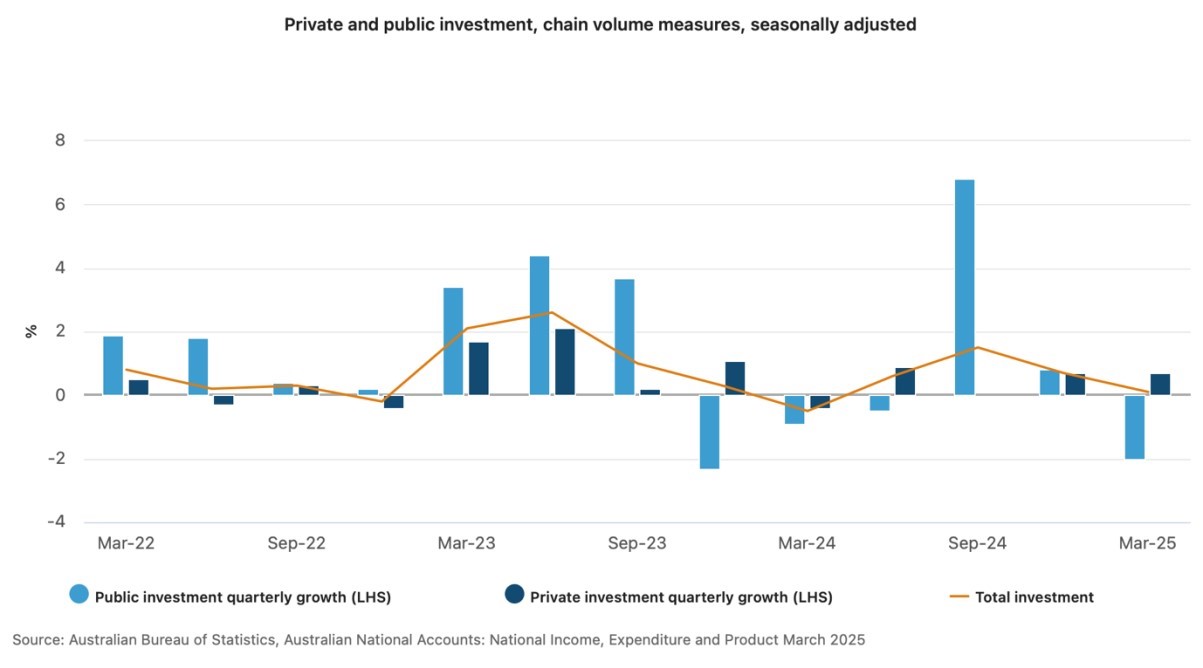
Figure 1
It is time for a re-consideration of the importance of Jean-Baptist Say’s contribution to economic thought, in particular to the importance of supply-side production and technological advances to economic growth.
References
Baumol, W. J. (1999). Retrospectives: Say’s law. Journal of Economic Perspectives, 13(1), 195-204.